Invisible early effort
In early recovery, a patient may try to move with no visible motion. That residual muscle activity is hard to see, and motivation fades when nothing seems to happen.

NeuroMyoCloud is a clinic-first software platform that turns residual muscle activity after stroke into therapist-supervised biofeedback, serious-game training and objective progress data.
Built on a working technical proof of principle developed in the n-squared lab at FAU Erlangen-Nürnberg. Not yet a clinically validated stroke product; clinical validation is planned.
Millions of people survive strokes each year and begin long rehabilitation journeys. The early effort that matters most is the hardest to see.
In early recovery, a patient may try to move with no visible motion. That residual muscle activity is hard to see, and motivation fades when nothing seems to happen.
One therapist supports many patients. High-quality, individual feedback for every repetition is hard to deliver, and home exercises are often done without guidance.
Progress is often judged by observation and memory rather than continuous data, which makes therapy harder to adjust and harder to justify to payers.
NeuroMyoCloud reads the small electrical signals muscles produce (EMG), even when little or no movement is visible, and turns them into real-time feedback the patient and therapist can both see.
The platform is designed to support therapy. It is intended to make residual muscle activity visible and engaging, not to replace clinicians and not to guarantee any clinical outcome.
A technical proof of principle exists today. Clinical validation with patients is planned.
Four steps turn a muscle attempt into a visible, rewarding response and into objective data.
A high-density EMG band records muscle activity on the forearm, sampling many channels in parallel.
Signal processing and machine learning translate those signals into the patient's intended gesture in real time.
The intended movement drives a serious game and live biofeedback, so even small efforts create visible, rewarding responses.
Every session becomes objective data on activation, consistency and progress for the therapist to review.
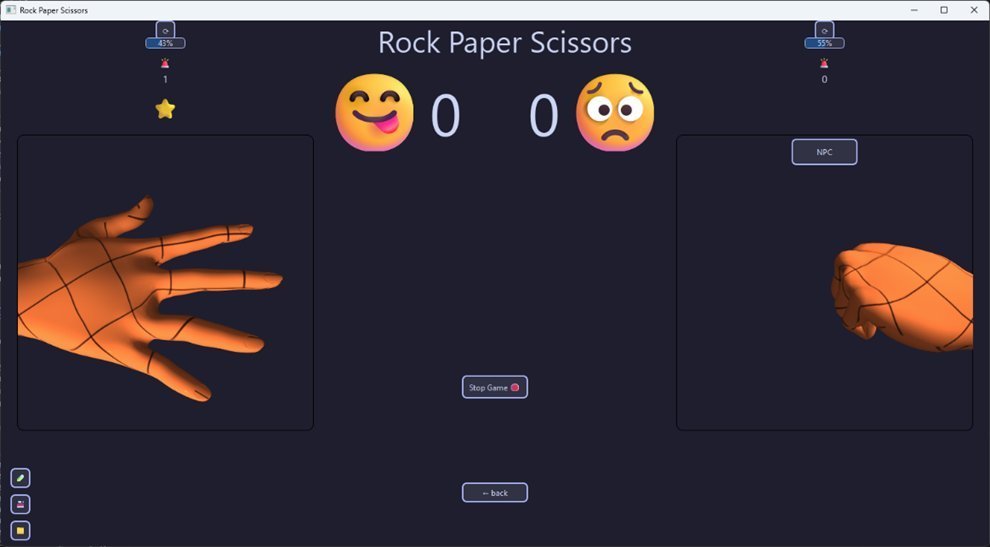
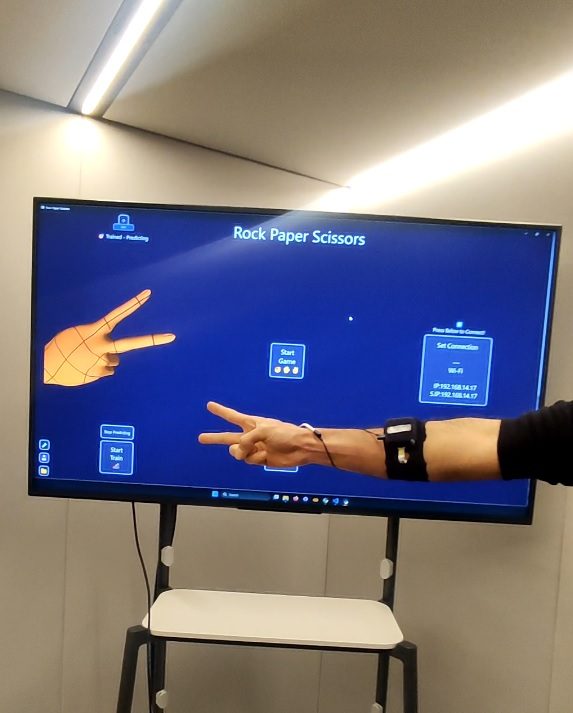
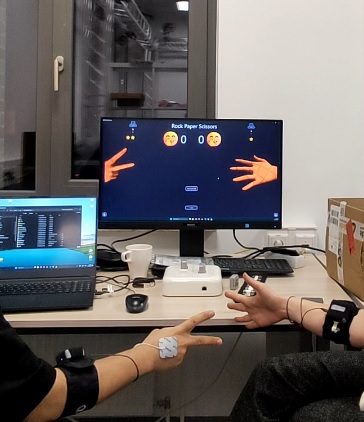
We have already built and tested a working prototype: a Rock-Paper-Scissors game controlled entirely by muscle activity through a high-density EMG bracelet. It is a technical proof of principle, not a clinical study.
This prototype demonstrates the core technology only. NeuroMyoCloud is not yet a clinically validated stroke product. Clinical evaluation with patients is planned together with clinical partners.
NeuroMyoCloud is designed to fit existing rehabilitation workflows and to keep therapists in control.
Interested in a clinical pilot?
Talk to us about a pilotWe start where the technology creates clear value and where buyers exist today: rehabilitation clinics and centers.
Sell to rehabilitation clinics and centers as a supervised therapy tool (B2B).
Recurring software licensing per site, with hardware and onboarding.
Session data supports therapy decisions and reimbursement cases.
Extend to supervised home-based training, broadening reach beyond the clinic.
Revenue model and pricing are early and indicative. They will be refined with clinical partners and customer discovery.
Stroke rehabilitation is a large and growing need worldwide. Our strategy is to enter through a focused, reachable segment first.
We do not need the whole market. We need a focused beachhead of clinics where the technology creates clear value.
NeuroMyoCloud combines clinical-grade EMG with engaging, software-driven training and objective data.
An indicative plan across five tracks. Timelines will be refined with partners.
Scroll horizontally to see the full plan →
A small founding team combining hands-on EMG engineering, a clinically grounded scientific advisor, and business and go-to-market experience.
Rehabilitation robotics · neurorehabilitation
A professor specialising in assistive and rehabilitation robotics, focused on upper-limb motor recovery after stroke. Their work spans human-robot interaction, adaptive assist-as-needed therapy that promotes motor learning, and moving rehabilitation from the clinic toward the home, backed by hands-on medical-device and regulatory experience (EU MDR, IEC 60601). Guides the team on clinical validation strategy, therapy design and the regulatory pathway.

Co-founder · CEO / CTO
M.Sc. Medical Robotics. Built the EMG-to-game prototype end to end, from high-density signal processing and machine learning to the real-time application. Leads product and technology.

Co-founder · CMO / CFO
Leads business strategy, commercialization and finance, focused on bringing the platform to clinics and building the go-to-market and partnership model.
We plan to expand the team with clinical, regulatory and commercial expertise as we move toward clinical pilots.
Engineering, clinical insight and commercial drive in one team.
An early-stage, high-upside opportunity in stroke rehabilitation, built on a working technical prototype and a clear clinic-first path.
Rehabilitation is shifting toward digital, data-driven and engaging therapy. EMG decoding that was once lab-only is becoming practical.
A working EMG-to-game proof of principle, validated as a technical demonstrator, with strong measured accuracy in testing.
Clinic-first focus, EMG expertise in-house, and a design built around therapists and objective data.
An indicative pre-seed allocation across 18 months, focused on reaching clinical pilot readiness.
Allocations are indicative and will be refined with partners and customer discovery.
Whether you run a rehabilitation clinic or invest in early-stage MedTech, we would like to talk.
Interested in supervised use or a clinical pilot? We would value your input as we shape the platform.
Start a conversationWe are raising a pre-seed round. Request our summary and the story behind the prototype.
Request the summary